





This guide sets out a Wegovy results timeline grounded in the trial data, covering the first months and escalation, the six-month review, the 68-week (STEP 1) figures and the two-year (STEP 5) data. It draws on the UK Summary of Product Characteristics and the NHS, and it pairs with our guide on the dose schedule. The figures are trial averages, not promises.
A realistic results timeline
The first thing to understand is that Wegovy results are gradual and cumulative, not instant 2. The dose is built up over a 16-week escalation, and weight loss in the trials occurred early and then continued over many months rather than arriving all at once 12.
It is also essential to read the figures correctly: the numbers below are trial averages from people using the medicine alongside a reduced-calorie diet and increased physical activity, which is how it is licensed and how the NHS frames it 1. They describe what happened on average in studies, not a guaranteed personal result 1.
With that in mind, the sections below walk through the timeline: the first months, the six-month review, the roughly one-year (68-week) picture, and the two-year data 12.
The first months and the escalation
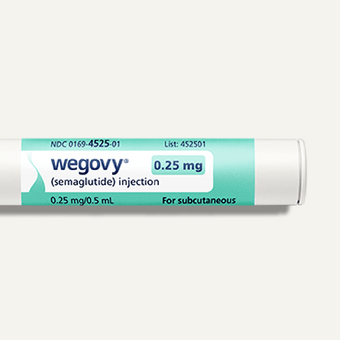
Treatment starts at a low 0.25 mg dose and is escalated over 16 weeks to the 2.4 mg maintenance dose, a schedule designed to reduce gut side effects rather than to maximise early weight loss 2. So the first months are partly about getting established on the dose.
Even so, the trials showed weight loss began early and continued, so the first months are not a flat period, but the larger cumulative effect builds as the dose reaches and stays at maintenance 12. Appetite reduction and earlier fullness are often noticed during this phase 1.
A realistic way to picture the early months is that the dose and the effect rise together. While you are stepping up through the lower strengths, the appetite-reducing effect is still building, so the steepest part of the weight-loss curve tends to come once you are established on the maintenance dose rather than in the very first weeks 12. That is why it is worth not reading too much into the scales during the escalation itself, and treating the first months as laying the groundwork for the more substantial loss that the trial figures show over the following months 1.
Our guide on the Wegovy dose schedule sets out the escalation week by week, which is the backbone of the early timeline 2.
Around 6 months: the review point
Six months is the key early checkpoint. Both the medicine's licence and NICE use a 5 percent weight loss at six months as the marker for whether treatment is working well enough to continue 2. So by six months, a meaningful response should be visible.
The trial data is encouraging here: in the main 68-week trial, after about 28 weeks (close to six months), around 89.8 percent of people on Wegovy had achieved at least a 5 percent weight loss 1. So most people reached the checkpoint comfortably, though individual results vary 1.
The six-month review is therefore both a clinical decision point and a realistic milestone to set your own expectations around, rather than judging progress week by week 2.
It also reframes what the first six months are for. Rather than a period in which to chase the biggest possible number, they are better seen as the time to reach a tolerated dose and to establish whether you are a good responder, with the 5 percent marker as the test 12. Most people in the trials cleared that bar comfortably, but the point of the checkpoint is to make an honest, individual decision about continuing, taking the benefit and any side effects into account, rather than to pass or fail against someone else's result 12.
Considering treatment for weight management? You can start an assessment with a Cloud Pharmacy clinician, who will review your medical history and confirm whether treatment is appropriate.
Around 12 to 16 months: the STEP 1 picture
The clearest medium-term figures come from the main 68-week trial (STEP 1), which is roughly 15 to 16 months of treatment 1. In that trial, average weight loss on Wegovy was about 14.9 percent of body weight, compared with about 2.4 percent on placebo 1.
Breaking that down, in STEP 1 about 83.5 percent of people lost at least 5 percent of their weight, 66.1 percent lost at least 10 percent, 47.9 percent lost at least 15 percent, and 30.2 percent lost at least 20 percent 1. These bands give a more realistic sense of the spread of results than a single average 1.
It is worth repeating that these are trial averages with diet and activity support, and individual results vary considerably; they are a guide to what the medicine can do, not a promise for any one person 1.
The threshold bands are arguably more useful than the headline average, because they show the spread 1. They tell you that a substantial majority lost at least a tenth of their body weight, that nearly half lost at least 15 percent, and that a significant minority lost a fifth or more, while also implying that some people lost less 1. Reading the figures this way, as a distribution of outcomes rather than a single number everyone hits, is the honest way to set your own expectations, since where you fall within that range depends on factors covered later in this guide 1.
Up to 24 months: the two-year data
For the longer view, a two-year trial (STEP 5) assessed semaglutide 2.4 mg over 104 weeks 3. Its main relevance to a results timeline is that weight loss was sustained over the two years, rather than being quickly regained while on treatment 3.
So the 24-month picture is less about further large drops and more about maintaining the loss achieved, which fits the idea that the maintenance dose holds the result while treatment continues 13. This is why the medicine is described in terms of weight loss and weight maintenance 1.
The two-year data also underlines that results depend on continuing treatment and the lifestyle changes alongside it, a theme our guide on keeping weight off explores 1.
This shift in what 'progress' means over time is worth holding onto, because it changes how you should read the scales 1. In the first year, progress is mostly about the loss itself; in the second year, success looks more like holding that loss steady rather than continuing to drop at the same pace 13. Expecting the same rate of loss to continue indefinitely sets an unrealistic bar, whereas understanding that the later phase is about maintenance makes a stable weight feel like the achievement it is 1.
Why results vary and how to sustain them
Individual results differ, which is why the figures above are ranges and averages rather than a single promise 1. How closely the diet-and-activity side is followed, the dose tolerated, and individual biology all feed into where a person lands within that spread 1.
Because the medicine is an adjunct to diet and activity, the lifestyle changes are part of the result and important for keeping weight off, especially given that stopping can lead to some regain 1. Sustained results come from the combination, not the injection alone 1.
So a realistic way to use this timeline is to expect a gradual build, treat six months as the first real checkpoint, look at the one-year and two-year trial figures as a guide to the range of outcomes, and focus on the lifestyle habits that sustain the result 12. Held that way, the timeline becomes a tool for setting honest expectations rather than a scorecard to measure yourself against week by week 1.
It also helps to judge your own progress against the trend over months rather than the scales on any single day 1. Weight loss in the trials was not perfectly linear, and periods where the rate slows are normal, particularly once you are established on the maintenance dose, so the six-month and longer checkpoints are a fairer measure than any one week 12.
Frequently asked questions
How much weight can you lose on Wegovy?
In the main 68-week trial, average weight loss was about 14.9 percent of body weight, with around 83 percent losing at least 5 percent, 66 percent at least 10 percent, and 30 percent at least 20 percent 1. These are trial averages used alongside diet and activity, and individual results vary, so they are a guide rather than a guarantee 1.How long does Wegovy take to show results?
Results build gradually. The dose is escalated over 16 weeks, and weight loss in the trials began early and continued over many months 12. The recognised checkpoint is at least 5 percent weight loss by six months; in the main trial, around 90 percent had reached that by about 28 weeks 12.What results should I expect at 6 months on Wegovy?
Six months is the review point, with at least 5 percent weight loss used as the marker for continuing 2. In the main trial, about 89.8 percent of people had achieved at least 5 percent by around 28 weeks 1. Individual results vary, so it is a realistic milestone rather than a fixed target 12.Do Wegovy results last after a year or two?
A two-year trial (STEP 5) showed weight loss was sustained over the two years on treatment rather than quickly regained 3. The 24-month picture is more about maintaining the loss than further large drops, which fits the medicine being described as weight loss and weight maintenance 13.Why are my Wegovy results different from someone else's?
Individual response varies, and results depend on how closely the diet-and-activity side is followed, the dose tolerated and individual biology 1. The trial figures are averages and ranges, not a single promise, so where you land within the spread is personal 1. Judge progress over months, not single weeks 1.Will I keep the weight off after stopping Wegovy?
Stopping can lead to some weight being regained, which is why the diet-and-activity changes alongside the medicine matter so much for the longer term 1. The two-year trial showed results were sustained while on treatment 3. Keeping weight off is covered in our guide on that topic 1.Your next step
Wegovy results build gradually: the dose is escalated over 16 weeks, six months is the review point with a 5 percent marker, the main 68-week trial showed average weight loss of about 15 percent with a wide spread, and a two-year trial showed the loss was sustained. These are trial averages used alongside diet and activity, not guarantees for any one person.
Use the timeline to set realistic expectations: expect a gradual build, treat six months as the first real checkpoint, read the one-year and two-year figures as a guide to the range of outcomes, and focus on the lifestyle habits that sustain the result. Review your own progress with your prescriber against the trend over months rather than the scales on any single day, since weight loss in the trials was not perfectly steady and periods where the rate slows are entirely normal.
Disclaimer
This guide is for general information only and does not constitute medical advice, diagnosis or treatment. The information here describes general clinical context based on UK regulatory sources cited above; it is not a recommendation for any specific medicine or treatment, which can only be made by a prescriber following individual assessment.
If you are considering treatment, speak to your GP or pharmacist, or arrange a consultation with a Cloud Pharmacy clinician. Prescription-only medicines are issued only after clinical assessment and where appropriate.
If you experience side effects from any medicine, you can report them through the Yellow Card scheme at yellowcard.mhra.gov.uk.