





This guide explains the Mounjaro injection itself: what is in the pen, why tirzepatide is given by injection rather than swallowed, how and where to inject it, the weekly schedule, and how to store the pen so the medicine stays effective. The clinical detail comes from the UK Summary of Product Characteristics and the NHS.
What the Mounjaro injection is
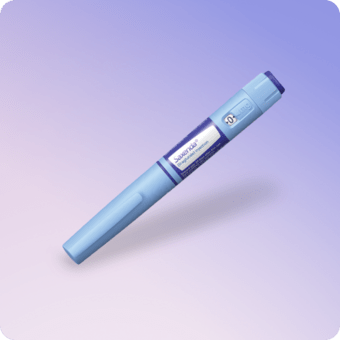
Mounjaro is the brand name for tirzepatide, supplied as a pre-filled KwikPen that delivers the medicine as a solution under the skin 1. The solution is clear and colourless to slightly yellow 3. Each pen is a multiple-dose device holding four weekly doses of 0.6 ml, and the pens come in six strengths from 2.5 mg to 15 mg of tirzepatide per dose 2.
Each dose contains the labelled amount of tirzepatide, so the 5 mg pen delivers 5 mg per 0.6 ml dose 2. The solution also contains a small amount of benzyl alcohol as an excipient, which the SmPC notes because it can rarely cause allergic reactions 2. Tirzepatide is a prescription-only medicine, so the pen is supplied only after a clinician confirms it is suitable for you 9. It is also a relatively new medicine under additional safety monitoring, marked by a black triangle, and the SmPC asks patients and healthcare professionals to report any suspected side effects through the MHRA Yellow Card scheme, which helps keep the safety picture up to date 5.
A practical point about the multiple-dose pen: each KwikPen holds four weekly doses, so one pen typically covers about a month at a single strength 2. When your dose is increased during titration, you move to a pen of the higher strength rather than taking more from the old one 1. That is worth knowing so you do not run a pen down past its intended four doses.
If you are getting to grips with the device itself, our step-by-step guide on how to use the Mounjaro KwikPen walks through priming and injecting, and the patient instructions that come with the pen are the definitive reference for your specific device 1.
Why it is an injection and not a tablet
Tirzepatide is licensed in the UK only as a subcutaneous injection, meaning under the skin 1. There is no licensed tirzepatide tablet. The injection is given just once a week, which is possible because tirzepatide stays in the body for a long time, with a half-life of around five days 4.
That long half-life is also why the medicine produces a steady effect across the week rather than a sharp peak and trough each day. It is part of the reason a missed dose does not immediately undo your progress, and why there are clear rules, set out below, about when to take a late dose and when to skip it 1.
The long half-life also means the medicine reaches a steady level in the body after the first few weeks, so each injection tops up an existing level rather than starting from zero. That is why a single late dose within the allowed window does not undo your progress, and why the gut side effects tend to be strongest at the start and after each dose increase, when the level is changing most 4.
A once-weekly injection suits some people better than a daily tablet and suits others less well. The format is a genuine consideration when comparing options, alongside how each medicine works and how you tolerate it. Our overview of weight-loss treatments sets out the injectable and oral options side by side.
How and where to inject Mounjaro
Mounjaro is injected into the fatty tissue under the skin of the abdomen (tummy), thigh or the back of the upper arm19. The dose can be given at any time of day, with or without meals 1. You inject once a week on the same day where you can.
Rotate the injection site with each dose 1. The NHS advises that you can use the same general area but should not use the exact same spot each time, which helps reduce skin reactions 9. If you also inject insulin, use a different injection site for the insulin 1. Injecting into the back of the upper arm usually needs another person to help 9.
Injection site reactions such as redness and itching can happen and are usually mild; in the weight management trials they affected around 8 percent of people on tirzepatide compared with about 2 percent on placebo 5. Rotating sites and following the pen instructions carefully both help. Read the instructions for use and the leaflet before you inject 1.
| The Mounjaro injection | What the SmPC and NHS say |
|---|---|
| How often | Once a week, on the same day where you can 1 |
| Where | Under the skin of the abdomen, thigh or back of the upper arm 1 |
| When | Any time of day, with or without food 1 |
| Rotation | Change the spot each time; use a separate site from any insulin 19 |
| Changing your day | Allowed, as long as there are at least 3 days between doses 1 |
| Storage | Keep in the fridge until you are ready to use it 9 |
The dosing schedule and missed doses
The injection is started low and built up. The SmPC starting dose is 2.5 mg once weekly for four weeks, then 5 mg once weekly, with any further increases made in 2.5 mg steps after at least four weeks at the current dose, up to a maximum of 15 mg once weekly 1. The recommended maintenance doses are 5, 10 and 15 mg 1. Our Mounjaro dose guide explains the titration in full.
You can move your injection day if you need to, as long as there are at least three days between two doses 1. If you miss a dose, take it as soon as possible within four days of the missed dose; if more than four days have passed, skip it and take your next dose on the usual day 1. Never give yourself two injections to make up for a missed one 9. Our article on what to do if you miss a dose covers the safe steps.
If you use more than your prescribed dose, the NHS advises getting medical advice, because too much tirzepatide can sometimes be dangerous 9. In overdose, the main effects are gastrointestinal, such as nausea, and there is no specific antidote, so treatment is supportive 6.
Storing the pen and handling it safely
The NHS advises keeping your Mounjaro injection in the fridge until you are ready to use it9. Following the storage instructions matters because tirzepatide is a temperature-sensitive protein, and storing it incorrectly can affect how well it works.
Your pack and patient leaflet give the precise temperature range and the rules for how long a pen may be kept out of the fridge once you start using it. Our guide on Mounjaro storage and room temperature rules covers the practical side, including travel and what to do if a pen has been left out. When in doubt, your pharmacist can confirm whether a pen is still safe to use.
Always check the solution before injecting. It should be clear and colourless to slightly yellow 3. Do not use a pen if the solution looks cloudy, discoloured or contains particles, and ask your pharmacist for advice if you are unsure.
What to expect after injecting
The most common effects after starting are gastrointestinal: nausea, diarrhoea, vomiting, constipation and abdominal pain 5. They are usually mild to moderate, tend to appear during dose increases, and ease over time as the body adapts 5. Our guide on managing nausea, bloating and constipation has practical tips, and the side-effect timeline shows what tends to happen week by week.
Most side effects settle, but some symptoms need attention. The SmPC asks you to seek immediate medical advice for persistent, severe abdominal pain, which can be a sign of acute pancreatitis 5. The gut effects can also cause dehydration, so it is worth keeping your fluids up, particularly if you are older 5.
The NHS sets out the serious effects to watch for in plain terms. They are rare, but they include a severe allergic reaction, low blood sugar (more likely if you also take other diabetes medicines), an inflamed pancreas, and gallstones or gallbladder swelling that causes severe tummy pain 9. The NHS advises calling 111 if you think you might be having serious side effects, and not driving or cycling if you feel dizzy or have vision problems after injecting 9. Knowing this list in advance makes it easier to tell ordinary early nausea from something that needs a call.
One practical point that often surprises people: tell any healthcare team before an operation or procedure involving general anaesthesia or sedation that you take tirzepatide, because the slower stomach emptying can increase the risk of stomach contents entering the lungs 5.
Because the injection slows stomach emptying, it can also change how other medicines you swallow are absorbed 7. The SmPC advises monitoring if you take oral medicines with a narrow margin of safety, such as warfarin or digoxin, especially when you start or increase the dose 7. It can also reduce the absorption of the contraceptive pill, so the SmPC advises adding a barrier method or switching to a non-oral method for four weeks when you start and for four weeks after each dose increase 7. Tell your prescriber and pharmacist about everything you take before you start.
Frequently asked questions
Does the Mounjaro injection hurt?
Mounjaro is injected into the fatty tissue under the skin with a fine needle, and most people find it causes little discomfort 1. Mild injection site reactions such as redness or itching can happen and are usually mild 5. Rotating the site each week and following the pen instructions both help. Our guide on how to use the KwikPen covers the technique.What time of day should I inject Mounjaro?
The SmPC says Mounjaro can be injected at any time of day, with or without meals 1. The main rule is to keep to the same day each week where you can, and to leave at least three days between doses if you move your injection day 1. Pick a time that is easy to remember and fits your routine.Can I keep my Mounjaro pen out of the fridge?
The NHS advises keeping the pen in the fridge until you are ready to use it 9. Your pack and leaflet state the exact temperature range and how long a pen may be kept at room temperature once in use. We cover this in our storage guide, and your pharmacist can confirm whether a pen left out is still safe to use.Where is the best place to inject Mounjaro?
The licensed injection sites are the abdomen, thigh and back of the upper arm 1. There is no single best site; the important thing is to rotate where you inject so you are not using the exact same spot each week, which helps reduce skin reactions 9. If you inject insulin too, use a separate site for it 1.Your next step
The Mounjaro injection is more straightforward than it first appears: a once-weekly dose under the skin, rotated between the tummy, thigh and upper arm, kept in the fridge until use, and built up gradually from a low starting dose. The technique is learnable and the schedule is forgiving within limits.
If you are considering Mounjaro, speak to your GP or pharmacist, or start a consultation with a clinician who can confirm whether it is appropriate for you and show you how to use the pen safely. Read the instructions that come with your specific device, and ask your pharmacist if anything about storage or injecting is unclear.
Disclaimer
This guide is for general information only and does not constitute medical advice, diagnosis or treatment. The information here describes general clinical context based on UK regulatory sources cited above; it is not a recommendation for any specific medicine or treatment, which can only be made by a prescriber following individual assessment.
If you are considering treatment, speak to your GP or pharmacist, or arrange a consultation with a Cloud Pharmacy clinician. Prescription-only medicines are issued only after clinical assessment and where appropriate.
If you experience side effects from any medicine, you can report them through the Yellow Card scheme at yellowcard.mhra.gov.uk.